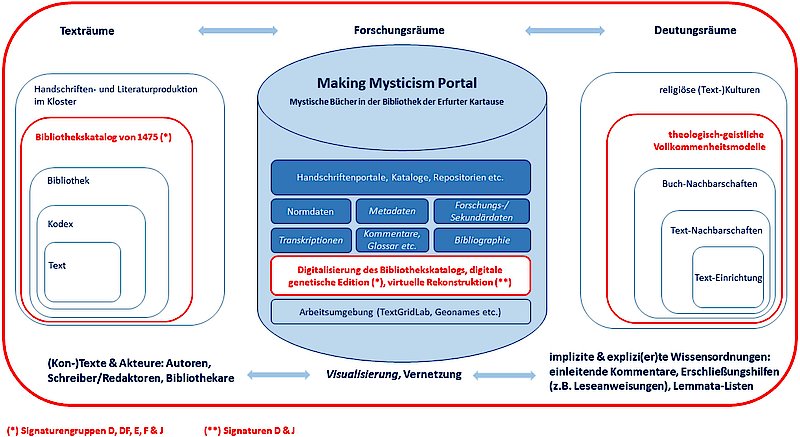

In the Middle Ages, the term "mysticism" was not yet used as a historiographical category. Any attempt to write a history of mysticism must therefore first ask how such a category began to emerge. The historical library of the Carthusian Monastery in Erfurt offers an exceptional example for this study; its surviving catalog includes groups of shelfmarks that would be classified as "mystical literature" today. Using these historically documented holdings and their underlying discursive structures, the project explores how the classificatory and descriptive category of "mysticism" can be understood through a historical lens.
The objective of the project are the virtual reconstruction, a digital genetic edition, and a comprehensive philological analysis of the relevant shelfmark groups. This approach allows for a vivid reconstruction of the collection of "mystic books" at the Carthusian Monastery in Erfurt, outlining its profile through the lens of literary, library, philosophical, and theological history.
The project will conclude with a symposium focusing on the nature of the Erfurt Carthusian library, its catalog, and its organisational structures of knowledge within the broader context of European Carthusian monastic culture in the Late Middle Ages. The conference will explore the interplay between close reading and distant reading. At the same time, the project will discuss the unique potential of the field of "Historical Collections and Digital Humanities", which arises from the close synergy between academic research and library expertise.